
For six weeks starting June 11, three countries will run the largest sustained special-event air traffic operation this continent has attempted. Sixteen host cities. Six million-plus visitors. Business aviation demand that planners have been comparing, without much exaggeration, to an Olympic Games stretched across a subcontinent.
Most of the coverage you will read about this is about football. This one is about the NOTAMs.
The stadium rings
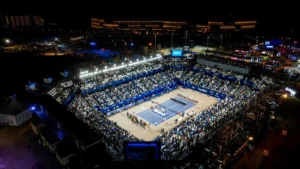
Expect a security temporary flight restriction over every match venue on every match day. The working shape, based on how the FAA has structured comparable events and what has been published so far, is a radius of roughly 3 nautical miles from the surface to 3,000 feet, activating around three hours before kickoff and lifting around three hours after the final whistle.
Aircraft transiting the outer areas must stay in contact with ATC and squawk the assigned code. Uncontrolled VFR wandering near a stadium on match day is the fastest way to end a trip badly.
Separately, the FAA has established no-drone zones covering stadiums, official fan events and team base camps. If your travel party includes a film crew, a photographer or a security detail that flies anything, that conversation needs to happen before you land, not at the FBO counter.
PPR: the reservation nobody tells the passenger about
This is the change most likely to strand an unprepared operator. A significant list of U.S. airports has published prior permission required NOTAMs, most on a 24-hour PPR basis:
- Boston (BOS)
- Los Angeles (LAX)
- Miami–Opa Locka (OPF) and Fort Lauderdale (FLL)
- Dallas Love Field (DAL)
- Kansas City area — MCI, MKC, LXT, GPH and IXD
- The New York/New Jersey complex — TEB, EWR, LGA, JFK
Newark goes further: from June 6 through July 20, an FBO reservation is required with N-number and call sign validation.
In Canada, Toronto (CYYZ) and Vancouver (CYVR) carry their own PPR requirements, with temporary restricted airspace established under Nav Canada’s aeronautical information circular.
Two operational details matter here. First, the PPR code goes in the flight plan — a reservation that exists only in someone’s inbox is not a reservation. Second, aircraft without one may be required to divert, with further enforcement action available to the FAA. “We will sort it out en route” is not a plan.
Flow programs are the invisible delay
Even with a valid PPR, arrival is not guaranteed to be on time. The FAA has signaled it will use the full traffic management toolkit: ground delay programs, airspace flow programs, ground stops, time-based metering, miles-in-trail and minutes-in-trail restrictions, and airborne holding.
The practical effect for a private trip is that departure timing becomes a strategic decision. Filing early, before a flow program activates, is worth more than any amount of speed once one is running. Post-match departures will bunch, and the aircraft that leaves 90 minutes after the whistle will often beat the one that tried to leave 20 minutes after it.
July 19: the hardest ring of the tournament
The final at MetLife Stadium will carry the most restrictive airspace of the six weeks. Based on the published plan, expect a layered structure:
- Inside roughly 10 nautical miles: general aviation prohibited, including at Newark and LaGuardia. Teterboro accessible only through TSA gateway screening.
- Between roughly 10 and 30 nautical miles: general aviation permitted on an active IFR or VFR flight plan, in two-way communication with ATC, squawking an assigned code, and not loitering.
- Gateway screening airports: aircraft bound for Teterboro that day are expected to pre-screen at Linden (LDJ), Philadelphia (PHL) or Lehigh Valley (ABE) before continuing.
Exact activation windows will be in the NOTAM. Read it the morning of, not the week before — and if the final is on your itinerary, treat Morristown (MMU) and Westchester (HPN) as serious options rather than fallbacks.
Where general aviation actually fits in Mexico
Mexico hosts thirteen matches across three cities, and its constraints are different in kind from the U.S. ones. Slots are part of the problem. Parking is most of it.
- Mexico City International (MMMX) has extremely limited general aviation access under normal conditions, largely restricted to charter. June will not improve this.
- Felipe Ángeles (MMSM) is where the larger aircraft go when overnight parking has been approved in advance.
- Toluca (MMTO) runs around the clock and absorbs most of the region’s executive traffic. This is where we are based.
- Guadalajara (MMGL) has full general aviation facilities, with additional FBO capacity that came online in March 2026.
- Monterrey (MMMY) is the main general aviation field for the northeast, with Saltillo (MMIO) about an hour away as a credible alternate when parking tightens.
The Mexican permit clock
AFAC’s rules did not relax for the tournament, and the lead times are the binding constraint:
- Charter missions generally require around ten business days of notice.
- Private, non-revenue operations have used single-entry authorizations since 2024; the old annual multiple-entry permits are gone.
- APIS is mandatory for arrivals and departures, transmitted before wheels-up.
- Insurance documentation must match aircraft make, model, serial and registration exactly. Not approximately.
- General aviation and charter access is limited to a defined list of public-use airports, which narrows the alternate options that used to exist.
Mexico City’s airspace is saturated on an ordinary Tuesday. Layer a World Cup on top and the margin disappears.
What we are doing about it
Our operations team has been working permits, parking and handling for June and July since the winter, because the airports that matter here allocate on a first-confirmed basis and not a first-asked one. We file APIS, verify insurance language, confirm PPR codes into the flight plan and coordinate with local authorities ahead of arrival.
We are also being direct with clients about a specific trade-off: aircraft that can drop passengers and reposition will move far more freely over these six weeks than aircraft that need to occupy a ramp for four days. In several cases the better answer has been two shorter positioning legs rather than one long stay.
If your tournament plan currently exists as a list of match tickets and a hope, this is the week to convert it into a flight plan.