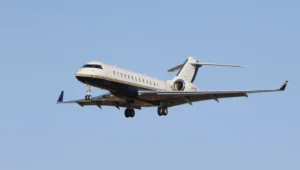

Most people choosing a charter operator will ask about audit certification, crew training and maintenance history. Very few ask a single question about the car waiting at the other end.
The two decisions belong to the same trip. They rarely get the same attention. On a Toluca–Monterrey run, the flight is roughly an hour and fifteen minutes of highly regulated, twice-audited, fully documented activity. The drive from the FBO to a meeting in San Pedro is thirty to fifty minutes of whatever you arranged. One of those halves has a checklist. The other usually has a WhatsApp thread.
This is not an argument for paranoia. It is an argument for symmetry.
What private aviation actually buys you, and where it stops
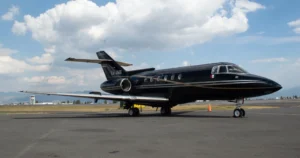
The value of a private flight is not speed in the air. A Hawker 800 is not dramatically faster than an A320. The value is the removal of queues, fixed schedules, and exposure to other people’s timetables — and almost all of that value is created on the ground, at the two ends.
At Toluca that advantage is real and measurable. Our FBO puts you from car to cabin in minutes rather than hours, with customs and immigration coordinated in advance rather than queued for. The airport sits at 8,730 feet with a 14,140-foot runway and CAT II/IIIA approaches, about 30 kilometers from Santa Fe, which is why it functions as the executive gateway to the Valley of Mexico instead of a secondary field.
But the moment the aircraft door closes behind you on arrival, the trip stops being an aviation problem and becomes a ground problem. Most of the friction, most of the delay, and effectively all of the risk in a well-run private trip live in that transition.
The three handoffs where trips actually break
Handoff one: ramp to vehicle. Who is authorized to be on the apron, and who is not? At most Mexican FBOs, airside vehicle access requires prior credentialing of both driver and vehicle. If nobody arranged it, your car is waiting in the public lot, and the walk you did not plan for is the part of the trip you will remember.
Handoff two: vehicle to route. A driver who does not know the destination is a driver improvising in traffic. Routes should be selected before the wheels are down, with a primary and an alternate, and with someone who is not driving watching conditions.
Handoff three: arrival to entry. Building access, parking, and who is expecting you. This is the handoff most often left to the person you are meeting, which means it is the handoff nobody actually owns.
None of these are exotic. All three are solved by deciding, in advance, who is responsible for each one by name.
Airside or landside, and why it matters more than the car
Airside pickup — the vehicle staged on the ramp, next to the aircraft — eliminates the walk, the wait, and the observable pause between aircraft and car. It requires credentialing, it is not available everywhere, and it takes coordination with the FBO and the airport authority.
Landside pickup is perfectly reasonable at many fields. It simply needs to be a decision rather than a default. The failure mode is not landside pickup. The failure mode is discovering at 200 feet that you assumed airside.
Armor is a scale, not a switch
Clients often ask for “an armored car” as though that were one thing. It is not. Vehicle protection is graded. Reputable armorers work against published standards — EN 1063 for the glazing, VPAM BRV for the complete vehicle — and the practical distinction those standards draw is between the level that stops a handgun round and the level that stops a rifle round. The weight, the fuel consumption, the ride, the maintenance interval and the cost all move with it.
Two practical points that matter more than the badge on the certificate:
- The driver is the system. A well-trained driver in a modest vehicle outperforms an untrained one in a heavily armored vehicle, every time. Ask about the driver’s training, not just the car’s rating.
- Match the level to the route, not to the anxiety. A transfer inside a metropolitan business district and a three-hour drive through an unfamiliar state are different problems. The U.S. State Department’s Mexico travel advisory, updated regularly and organized state by state, is a neutral public reference worth reading before you decide — including for domestic travelers who know the country well but not that particular corridor.
Predictability is the variable you control
Most ground security literature converges on the same unglamorous conclusion: patterns matter more than hardware. Same car, same route, same hour, same week after week is the condition that creates opportunity. Varying departure times, alternating routes, and not announcing movements in advance costs nothing and does more than an upgrade in armor level.
Private aviation helps here in a way that is easy to miss. A schedule you set yourself is, by definition, harder to predict than one published by an airline.
What we handle, and what we tell you honestly
For clients who want it, we arrange armored ground transfers, and we coordinate the airside handoff at the FBO we operate in Toluca. Where we are flying into a field we do not control, we tell you plainly what is and is not possible there rather than promising a ramp pickup that the local authority will not authorize.
We also plan the ground leg into the flight plan rather than after it. If a 7:00 a.m. arrival means a transfer through peak traffic, the honest answer is often a 6:15 departure, not a faster car.
A short pre-trip checklist
- Confirm whether pickup is airside or landside, in writing, at least 24 hours out.
- Name the driver and the vehicle, and confirm both are credentialed if airside.
- Agree on a primary and alternate route to the destination.
- Confirm who at the destination is expecting you, and how they will be reached if timing slips.
- Decide the protection level based on the specific route, not the general reputation of the country.
- Keep arrival and departure times off group chats and public calendars.
The flight is the part of your trip that is audited, certified and rehearsed. The drive should not be the part that is guessed.